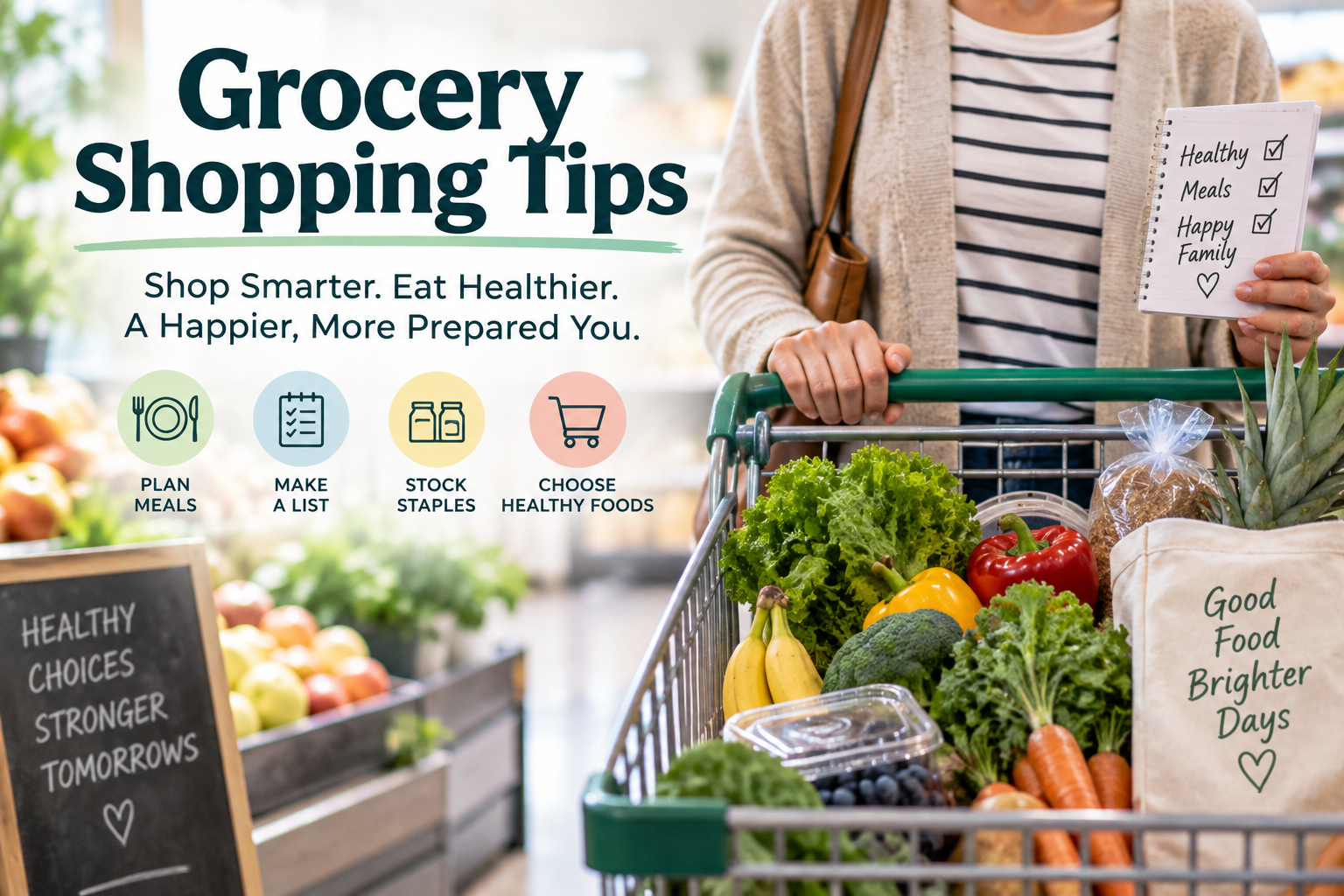
Healthy eating doesn’t start in the kitchen.
It starts at the grocery store.
What you put in your shopping cart eventually becomes what you see every time you open the refrigerator, what your family reaches for when they’re hungry, and what you have available when you need to make dinner after a busy day.
That’s why changing the way you shop can sometimes be easier than relying on willpower every time you reach for something to eat.
Over the years, I’ve developed a few grocery shopping habits that work particularly well for my family. I plan the week’s meals before shopping, keep a running list that everyone can contribute to, maintain a well-stocked pantry, and try not to bring home foods that I don’t really want us eating.
I don’t follow those rules perfectly. Treats can still find their way into the cart sometimes.
But that’s part of having a realistic system rather than a perfect one.
Here are some of my favorite grocery shopping tips for making healthy eating easier, reducing last-minute food decisions, and keeping your kitchen prepared for both busy weeks and unexpected situations.
1. Decide What You’re Going to Eat Before You Shop
One of the biggest changes you can make is deciding what you’re buying before walking into the store.
I have a collection of meals that I regularly make. Before grocery shopping, I decide which of those meals we’ll have during the upcoming week.
Then I buy what we need to make them.
It sounds obvious, but it solves several problems at once.
You’re less likely to wander around the store trying to invent meals.
You’re less likely to buy ingredients without knowing what you’ll do with them.
And when Wednesday evening arrives, you’re not staring into the refrigerator wondering:
“What can I possibly make for dinner?”
The ingredients are already there.
2. Create a Collection of Go-To Meals
You don’t need seven new recipes every week.
In fact, constantly searching for new meals can make meal planning unnecessarily complicated.
Instead, develop a collection of meals your household already enjoys.
Your list might include:
- Tacos or burrito bowls
- Pasta with vegetables
- Stir-fry
- Chili
- Soup
- Curry
- Homemade pizza
- Grain bowls
- Sandwiches or wraps
- Sheet-pan meals
When planning the week, choose several meals from your regular rotation.
You can always experiment with something new when you feel like it.
The goal isn’t culinary excitement every night.
It’s having reliable meals you know you can make.
3. Keep a Running Grocery List
This is one of the simplest grocery shopping tips, but it’s also one of the most useful in our house.
We keep a grocery list on the refrigerator.
When someone notices we’re running low on something, they add it to the list.
That means creating the shopping list isn’t one person’s responsibility.
It also avoids the classic situation where you come home from grocery shopping and someone immediately says:
“Did you get toothpaste?”
No.
Because nobody told me we needed toothpaste.
Lol.
The refrigerator list gives everyone a place to add things throughout the week instead of trying to remember everything on shopping day.
A shared phone app can accomplish the same thing if that works better for your family.
The important part is having one central list everyone can update.
4. Check Your Kitchen Before Leaving
Even with a running list, I like to check what we already have before shopping.
Look through your:
- Refrigerator
- Freezer
- Pantry
You may discover that you already have pasta, rice, canned beans, frozen vegetables, or other ingredients required for your planned meals.
This prevents buying duplicates and can reduce food waste.
It’s particularly useful for fresh ingredients. For dry and frozen foods, it can be helpful to overstock.
If there’s already half a bag of spinach in the refrigerator, perhaps you can incorporate it into one of this week’s meals rather than buying another bag and eventually throwing both away.
5. Keep Your Pantry Stocked With Staples
This is something I’ve come to value more and more.
I try to keep our pantry stocked with basic foods we regularly use.
Not because I’m preparing for some extreme disaster.
Because life is unpredictable.
Sometimes I simply don’t have time to go grocery shopping.
But there have also been situations where having extra food at home became much more valuable—winter storms, power outages and, most notably, the pandemic.
Having a reasonably stocked pantry gives you options when your normal routine gets disrupted.
Useful staples might include:
- Rice
- Pasta
- Oats
- Canned or dried beans
- Lentils
- Canned tomatoes
- Soup
- Nut or seed butter
- Whole-grain crackers
- Shelf-stable milk or alternatives
- Nuts and seeds
- Canned fish, if you eat it
- Meal replacement shake
- Cooking oils
- Herbs and spices
Your personal staples will depend on what your family actually eats.
There’s little benefit in filling your pantry with “emergency food” nobody likes.
6. Build a Pantry Around Meals, Not Individual Ingredients
This is an important distinction.
Don’t just collect random cans and packages.
Think about what you could actually make with them.
For example, keeping pasta is helpful.
Keeping pasta, tomato sauce, canned vegetables, and a protein source is much more useful because you can turn those ingredients into dinner.
Ask yourself:
“If I couldn’t grocery shop for several days, what meals could I make with what I have right now?”
You don’t need dozens of options.
Even three or four reliable backup meals can make a hectic week much easier.
7. Rotate Your Pantry Instead of Forgetting About It
A well-stocked pantry only works if you actually use what’s in it.
Don’t buy food for emergencies and leave it untouched for years.
Use your pantry staples as part of your normal cooking and replace them as they’re consumed.
For example, if you normally keep three cans of beans and use one this week, put beans on the grocery list.
That way your pantry stays stocked without accumulating large amounts of forgotten food.
Periodically check expiration or best-before dates as well, particularly for foods you don’t use frequently.
And don’t forget – when you add new items, add them behind what is already there.
This way the older items will get used first which helps reduce the risk something stays in the back of the pantry for years.
8. Make Healthy Food the Default at Home
Here’s one of my personal grocery shopping rules:
I try not to buy foods that I don’t want myself or my family eating.
This isn’t about declaring foods forbidden.
It’s about recognizing something very practical:
If cookies are sitting in the cupboard, someone is probably going to eat the cookies.
Most likely me.
If they’re not there, eating them requires considerably more effort.
Your home environment influences your choices.
You can either repeatedly rely on willpower…
or make the choice easier before you even get home.
That’s one reason grocery shopping is such an important part of healthy eating.
You’re deciding what your future self will have available.
9. But Buy the Treat Sometimes
Here’s where reality enters the picture.
Despite my rule about not buying foods I don’t want us eating…
Sometimes I buy the treats anyway.
And that’s okay.
Healthy eating doesn’t require creating a house where nobody is ever allowed to eat chocolate, chips, cookies, or ice cream.
The distinction I find useful is between default foods and occasional foods.
Most of what comes into the house supports how we want to eat.
Treats can still be part of life.
That feels much more sustainable than trying to create a perfect food environment and feeling like you’ve failed whenever something less nutritious enters the shopping cart.
10. Don’t Grocery Shop Extremely Hungry
You’ve probably heard this advice before because there’s a good reason for it.
Everything looks better when you’re hungry.
Foods you wouldn’t normally consider suddenly seem irresistible, and it’s much easier to make impulse purchases.
If possible, shop after eating rather than when you’re starving.
If that’s not practical, have a small snack before entering the store.
Your shopping list also becomes particularly useful here.
You don’t need to decide whether you need something.
You already decided at home.
11. Make Nutritious Convenience Foods Part of Your Plan
“Convenience food” doesn’t automatically mean unhealthy food.
Busy households benefit enormously from foods that require little preparation.
Depending on your preferences, that might include:
- Frozen vegetables
- Frozen fruit
- Pre-washed salad
- Canned beans
- Hummus
- Greek yogurt
- Pre-cut vegetables
- Whole-grain bread
- Rotisserie chicken
- Microwaveable brown rice or quinoa
- Individually portioned nuts
- Nutritious frozen meals
These products sometimes cost more than preparing everything yourself.
But consider the realistic alternative.
If a $4 bag of pre-cut vegetables gets eaten while a $2 whole vegetable gets forgotten in the refrigerator, the cheaper option didn’t actually save money.
Convenience has value—especially when it helps you eat well consistently.
12. Stock Your Freezer Too
Your freezer is one of the best tools for making healthy eating easier.
I like having foods available that don’t depend on perfect meal planning.
Useful options can include:
- Frozen vegetables
- Frozen berries
- Frozen fruit
- Whole-grain bread
- Leftover soups and chili
- Prepared portions of meals
- Frozen fish or other proteins
- Healthy frozen meals
Freezing leftovers is particularly helpful.
Instead of eating the same meal four days in a row, freeze some portions.
A few weeks later, you’ve got a homemade meal ready on a night when you don’t have time to cook.
13. Shop Mostly From Your List—but Leave Room for Discovery
A grocery list prevents random purchases, but it doesn’t need to become a rigid contract.
Sometimes you’ll find:
- Produce that’s particularly fresh
- Something useful on sale
- A healthy food you’ve never tried
- A convenient product that could make your week easier
It’s okay to adjust.
The purpose of the list is to give your shopping trip structure, not eliminate every spontaneous decision.
14. Read Nutrition Labels When They Actually Help
You don’t need to inspect every package like you’re conducting a scientific investigation.
But labels can be helpful when comparing similar products.
Depending on the food, you might compare:
- Protein
- Fiber
- Added sugars
- Sodium
- Saturated fat
- Serving size
- Ingredients
The important word is compare.
Nutrition labels become particularly useful when you’re standing in front of three similar products and trying to decide which one better fits what you’re looking for.
You don’t necessarily need to decide whether an individual food is simply “healthy” or “unhealthy.”
15. Think of Grocery Shopping as Designing Your Week
This may be the most important of all these grocery shopping tips.
You’re not simply buying food.
You’re setting up your environment for the next several days.
Every item you bring home becomes an option your future self or family can choose.
When you’re exhausted after work, what’s available?
When someone needs a snack, what’s easiest to grab?
When you unexpectedly can’t get to the grocery store, what meals can you make?
When everyone asks what’s for dinner, do you already have an answer?
Good grocery shopping makes all of those situations easier.
My Simple Grocery Shopping System
After trying different approaches, I’ve ended up with a fairly straightforward routine.
Step 1: Plan the week’s meals.
I choose from meals I already know how to make.
Step 2: Check the refrigerator list.
Everyone in the family can add items as we run out.
Step 3: Check the refrigerator, freezer, and pantry.
I see what we already have before buying more.
Step 4: Add ingredients for the planned meals.
This becomes the main part of the shopping list.
Step 5: Restock staples.
If we’ve used something we normally keep on hand, I replace it.
Step 6: Shop primarily from the list.
This reduces impulse buying and makes the trip faster.
Step 7: Keep the home environment in mind.
I try to buy the foods I actually want us eating during the week.
It’s not a complicated system.
That’s probably why it works.
Grocery Shopping Tips for a Busy Week
There will inevitably be weeks when even your normal planning routine feels like too much.
That’s when your pantry and freezer become particularly valuable.
Instead of abandoning healthy eating entirely, simplify.
Maybe dinner is pasta, tomato sauce, frozen vegetables, and a protein source.
Maybe you make eggs and whole-grain toast.
Maybe you pull a frozen homemade meal from the freezer.
For particularly hectic mornings or lunches, I also think there’s value in keeping nutritious grab-and-go options available. Depending on your needs, that could include Greek yogurt, fruit, nuts, or a nutritionally balanced meal replacement.
Convenience isn’t failure.
Sometimes convenience is exactly what makes a healthy habit sustainable.
How to Grocery Shop for Emergencies Without Going Overboard
My experience with winter storms, blackouts, and the pandemic changed the way I think about keeping food at home.
You don’t necessarily need a basement filled with years of supplies.
A more practical goal is resilience.
Ask:
Could my household comfortably eat if I couldn’t grocery shop for several days?
Think about foods that:
- Your family normally eats
- Store well
- Can create actual meals
- Don’t require unusual preparation
- Will be rotated through normal use
Also consider what would be useful during a power outage, when your refrigerator, freezer, oven, or other appliances might not be available.
The goal isn’t fear.
It’s avoiding a situation where a relatively ordinary disruption immediately becomes a food problem.
Frequently Asked Questions About Grocery Shopping
How can I grocery shop healthier?
Start before you enter the store.
Plan several meals, create a list, and make nutritious foods the majority of what you bring home.
Healthy eating becomes considerably easier when nutritious options are already available in your kitchen.
How often should I grocery shop?
There’s no perfect schedule.
Some households prefer one large weekly trip. Others buy pantry items less frequently and fresh produce several times per week.
Choose the schedule that fits your lifestyle while minimizing wasted food and unnecessary trips.
How can I stop impulse buying at the grocery store?
Shop from a list and avoid shopping when extremely hungry.
It can also help to remember that buying something isn’t just a decision about what you want right now.
You’re deciding what will be sitting in your kitchen all week.
What groceries should I always have at home?
That depends on what you eat.
Instead of following someone else’s “perfect pantry” list, identify the ingredients used repeatedly in your family’s favorite meals.
Keep those stocked.
Rice isn’t useful just because someone says it’s a pantry staple. It’s useful if your household actually eats rice.
Is buying convenience food unhealthy?
Not necessarily.
Frozen vegetables, canned beans, pre-washed salad, Greek yogurt, frozen fruit, and other convenient foods can make nutritious eating much easier.
Evaluate the actual food rather than assuming something is unhealthy simply because it’s convenient.
The Bottom Line
The best grocery shopping tips aren’t really about becoming better at grocery shopping.
They’re about making the rest of your week easier.
Plan several meals before you shop.
Keep a running family grocery list.
Maintain a useful supply of pantry and freezer staples.
Make nutritious foods convenient.
And think carefully about which foods you want readily available in your home.
But leave some room for flexibility too.
I try not to buy foods that I don’t want my family or myself eating regularly.
Do I occasionally come home with treats anyway?
Absolutely.
The goal isn’t perfection.
It’s creating an environment where most of the time, the easy choice is also a reasonably healthy choice.
When you approach grocery shopping that way, your shopping list becomes more than a list of things you need.
It becomes part of your plan for how you want your family to eat.