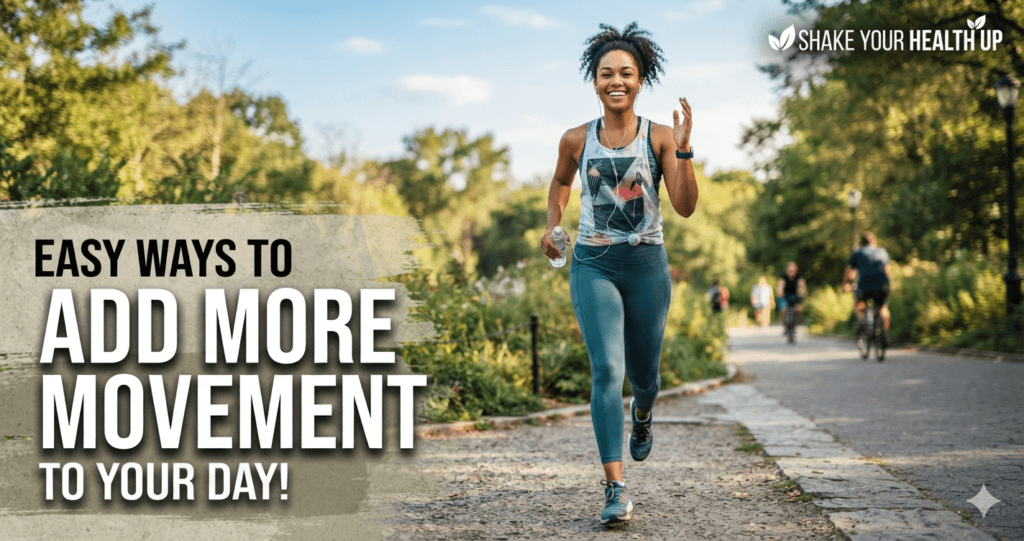
Being more active doesn’t have to mean finding another hour for the gym. Small amounts of movement can fit into things you’re already doing—and those small opportunities can add up.
When people decide they want to become more active, it’s easy to jump immediately to exercise.
Join a gym. Start running. Take a fitness class. Follow a workout program.
Those can all be great choices.
But there’s another part of an active lifestyle that’s easy to overlook:
Simply moving more during your normal day.
You might exercise for an hour in the morning and then spend much of the remaining day sitting at a desk, in a car, or on the couch. Or perhaps structured exercise doesn’t fit easily into your schedule right now.
Either way, becoming more active doesn’t have to start with finding a large block of free time.
Instead, ask:
Where could I naturally add a little more movement to the day I already have?
That’s today’s Shake Your Health Up approach.
Movement doesn’t have to be a workout
It’s useful to distinguish between structured exercise and everyday movement.
Structured exercise might include running, cycling, swimming, strength training, sports, or a planned workout.
Everyday movement includes things like:
- walking around the house
- taking the stairs
- doing yard work
- walking to a nearby destination
- getting up from your desk
- playing with your kids
- walking the dog
- carrying groceries
- cleaning
- doing home projects
Both can contribute to an active lifestyle.
The goal of this article isn’t to replace exercise with walking to the kitchen a few extra times.
It’s to stop treating movement as something that only counts when you’re wearing workout clothes.
There are opportunities to move throughout the entire day.
Let’s find some.
1. Take a short walk after a meal
This is one of the simplest places to start because meals already provide a natural cue.
Instead of creating an entirely new event called:
“Go for a walk”
attach the walk to something that already happens:
Finish lunch → walk for 10 minutes.
Or:
Finish dinner → go outside with the family.
The walk doesn’t need to be long enough to qualify as a workout.
You’re simply adding movement to something you already do.
Make it easier
Don’t set an ambitious target initially.
Try:
After dinner, I’ll walk for five minutes.
Five minutes may turn into 15 or 20 when you feel like it.
But on a busy day, five minutes still counts.
The important part is establishing the cue:
Meal finished → move.
2. Turn some phone calls into walking calls
If you’re taking a call that doesn’t require you to look at a screen or take detailed notes, consider walking while you talk.
That could mean:
- walking outside
- walking around your home
- pacing around your office
- walking through the building
- standing and moving rather than sitting
You don’t need to do this during every meeting.
Some conversations require your full attention at a computer.
But if you have a 20-minute call where you’re mostly listening and talking, ask:
Do I actually need to be sitting for this?
Sometimes the answer is no.
3. Create a movement cue at work
Hours can disappear surprisingly quickly when you’re concentrating.
You sit down to work at 9:00, look at the clock later, and somehow it’s lunchtime.
Rather than relying on yourself to remember to move, connect movement to events that already happen.
For example:
Finish a meeting → stand up and walk.
Finish a focused work session → get some water.
Go to the washroom → take the longer route back.
Finish lunch → go outside.
The principle is the same one we use throughout the free 7-Day Health Shake-Up guide:
Attach a new behaviour to an existing routine.
The existing routine becomes your reminder.
4. Take the stairs when it makes sense
“Take the stairs” is probably one of the oldest pieces of advice for adding activity to your day.
There’s a reason it keeps appearing.
It requires no special equipment, usually doesn’t add much time, and turns something you already need to do into an opportunity for movement.
But don’t turn it into another rigid rule.
If you’re going up ten floors, carrying something heavy, have mobility limitations, or stairs aren’t appropriate for you, use the elevator.
Instead, look for the easy opportunities.
One or two floors?
Try the stairs.
Going down?
Maybe take the stairs.
It’s an option, not a test of your commitment.
5. Park a little farther away
The objective isn’t to find the most inconvenient parking spot possible.
It’s simply to stop spending five minutes circling a parking lot because the closest space saves you a 90-second walk.
When it’s safe and practical, park a little farther from:
- work
- the grocery store
- a restaurant
- an appointment
- another destination
Then walk.
One slightly longer walk isn’t going to transform your health.
But that’s not really the point.
You’re developing a mindset of:
If moving a little more is easy, I’ll take the opportunity.
Those decisions can become automatic over time and add up to more movement.
6. Walk short trips when practical
Consider some of the trips you routinely make by car.
Are any close enough to walk?
Maybe it’s:
- a nearby store
- a coffee shop
- a friend’s house
- a park
- a mailbox
- dropping something off nearby
Obviously, distance, weather, available sidewalks, traffic, mobility, and personal safety all matter.
But sometimes driving is simply automatic.
The next time you’re heading somewhere nearby, ask:
Could I walk this one?
You might get movement, fresh air, and transportation from the same activity.
7. Don’t automatically optimize every chore
We spend a lot of effort making life more efficient.
Usually that’s useful.
But when it comes to movement, efficiency can sometimes work against us.
Imagine you’re cleaning the house.
You could gather everything that belongs upstairs and carry it all in one carefully organized trip.
Or you could make a few trips.
Normally I’d advocate efficiency.
But if you’re looking for ways to move more, you don’t always have to optimize movement out of your day.
The same applies to:
- bringing groceries inside
- putting laundry away
- cleaning
- gardening
- yard work
- organizing a room
- doing home improvement projects
These aren’t formal workouts.
They’re opportunities to use your body.
8. Make television slightly more active
There’s nothing wrong with sitting down and watching a show.
You don’t need to turn every moment of relaxation into exercise.
But television also creates some easy opportunities for movement.
You could:
- stretch during a break
- stand up between episodes
- walk around while deciding what to watch next
- do a few simple movements if you feel like it
- use an exercise bike or treadmill while watching occasionally
Or simply use the end of an episode as a cue:
Episode finished → stand up for a few minutes.
You’re not trying to eliminate relaxation.
You’re breaking up long periods of uninterrupted sitting.
9. Make movement social
Movement doesn’t have to be something you do alone.
Instead of always meeting someone for coffee or sitting around the house, occasionally suggest:
“Want to go for a walk?”
You can talk while you walk.
Other options include:
- walking with your partner
- taking the dog out together
- going for a family walk after dinner
- hiking with friends
- playing an active game
- going dancing
- cycling together
- joining a recreational sport
This is one of my favorite ways to think about movement because it stops being another health task.
The activity becomes something you’re doing with someone else.
The movement is almost a side effect.
10. Choose movement you actually enjoy
There’s a persistent idea that exercise has to feel like exercise.
It doesn’t.
If you hate running, you don’t need to become a runner simply because running is good exercise.
Maybe you’d rather:
- dance
- hike
- swim
- cycle
- garden
- play tennis
- play basketball
- walk
- do yoga
- lift weights
- play an active video game
- take a fitness class
- work on outdoor projects
The best activity isn’t necessarily the one that burns the most calories per minute or looks most impressive on a fitness app.
A more useful question is:
What kind of movement would I voluntarily do again?
Enjoyment is a powerful advantage when you’re trying to make something repeatable.
11. Create a five-minute minimum
One common barrier to movement is thinking there isn’t enough time.
You look at your schedule and think:
“I don’t have 45 minutes to exercise.”
Maybe you don’t.
But that doesn’t mean the only alternative is doing nothing.
Try creating a five-minute minimum.
If you don’t have time for a longer activity, do five minutes.
Walk around the block.
Go outside.
Move around the house.
Stretch.
Do a few simple exercises you’re comfortable performing.
Sometimes you’ll stop after five minutes.
Sometimes you’ll continue.
Either outcome is fine.
The five-minute rule removes one of the biggest barriers:
“If I can’t do enough, there’s no point doing anything.”
Something doesn’t have to be optimal to be worthwhile.
12. Use waiting time differently
We spend a surprising amount of time waiting.
Waiting for:
- food to cook
- coffee to brew
- someone to get ready
- an appointment
- a child at an activity
- a download or update
- a meeting to start
You don’t have to fill every spare minute with productivity.
But some waiting time can become movement time.
If you’re waiting for someone at an activity, perhaps take a short walk instead of sitting in the car.
If dinner is in the oven, tidy the kitchen or move around the house.
If you arrive early somewhere safe to walk, take a few minutes outside.
You’re not creating more time.
You’re using some of the time you already have differently.
13. Put things you use slightly farther away
Usually we arrange everything for maximum convenience.
For habits we’re trying to encourage, that’s exactly what we want.
But you can also intentionally create tiny amounts of movement.
For example, instead of keeping everything you need within arm’s reach at your desk, perhaps the printer, water bottle refill station, or something else requires you to stand up occasionally.
The objective isn’t to make your life annoying.
It’s to notice where extreme convenience has removed nearly all movement.
Then add a little back.
14. Try an active hobby
One reason structured exercise can be difficult to maintain is that the activity exists primarily because you’re trying to exercise.
An active hobby gives you another reason to move.
You might try:
- hiking
- dancing
- gardening
- recreational sports
- cycling
- swimming
- kayaking
- geocaching
- photography walks
- nature walks
- woodworking or DIY projects that involve physical activity
You’re learning something, spending time outdoors, socializing, creating something, or simply having fun.
Again, the movement becomes part of something else you value.
15. Make movement visible
The environment can help here too.
If something is hidden away, it’s easier to forget.
Depending on the activities you enjoy, that could mean:
- leaving walking shoes somewhere convenient
- keeping exercise clothes ready
- putting a yoga mat somewhere accessible
- keeping resistance bands where you’ll see them
- putting your bicycle somewhere easy to use
- preparing your gym bag the night before
Compare:
“I should exercise.”
with:
Walking shoes are beside the door.
One is an intention.
The other is a cue.
Small environmental changes can make the first step easier.
What about fitness trackers and step counts?
Fitness watches and activity trackers can be useful because they make something normally invisible—how much you’ve moved—visible.
For some people, seeing that they’ve been sitting for a long time provides a useful reminder to get up.
Step counts can also provide a simple way to observe whether one day was more active than another.
But don’t let the device turn movement into a pass/fail test.
There isn’t something magical that happens when your watch changes from 9,999 to 10,000 steps.
A better use of tracking is to ask:
What’s normal for me, and can I gradually build more movement into that?
If you’re normally relatively inactive, adding some movement may be more realistic than suddenly chasing an arbitrary number.
Do you still need structured exercise?
Adding everyday movement doesn’t mean structured exercise no longer matters.
Public-health guidance generally recommends that adults combine regular aerobic activity with muscle-strengthening activity, while also reducing sedentary time where practical.
But you don’t need to transform your entire activity level overnight.
If you’re currently inactive, starting with small, manageable amounts can be a much more approachable first step.
And if you already exercise regularly, everyday movement can complement your workouts.
Think of it as:
Planned exercise + an active everyday life
rather than:
Workout completed → movement finished for the day.
If you have a medical condition, injury, significant mobility limitation, or concerns about beginning exercise, get appropriate professional guidance before substantially changing your activity.
Exercise nutrition doesn’t need to be complicated either
Once people start exercising, another temptation appears:
“Now I need supplements, special drinks, protein powders, pre-workouts, recovery products…”
Not necessarily.
Your needs depend on the activity, duration, intensity, overall diet and individual circumstances.
For many ordinary activities, you don’t need anything special.
If you’re going for a 20-minute walk, you probably don’t need to develop a sophisticated sports-nutrition protocol around it.
For longer or more demanding exercise, nutrition and hydration may become more relevant.
That’s where some of the other resources on Shake Your Health Up can help.
→ Simple Ways to Make Hydration Easier
For people interested in convenient protein and meal replacement around an active lifestyle, I’ve also explained how I personally incorporate Isagenix shakes into my workout nutrition:
→ My IsaLean Shake Guide & Review
Those are tools—not prerequisites for moving your body.
Don’t use movement as punishment for eating
There’s one mindset I’d particularly avoid:
“I ate too much, so now I need to exercise.”
Movement doesn’t need to be punishment.
Neither does every activity need to be evaluated by how many calories it burns.
Walking can be worthwhile because:
- you enjoy it
- it gets you outside
- it breaks up sitting
- you spend time with someone
- you explore somewhere
- it helps movement become part of your routine
When movement is something positive you add to your life rather than something you use to compensate for food, it’s easier to build a healthier relationship with being active.
Create movement defaults
One of the most powerful strategies in this entire article is to decide in advance what you normally do.
For example:
If it’s one floor, I normally take the stairs.
After dinner, I normally go outside for a few minutes.
If I have a phone call that doesn’t require a screen, I normally walk.
If a destination is close and conditions are appropriate, I consider walking.
When I finish a long work session, I normally stand up and move.
Notice the wording.
You’re not constantly negotiating with yourself.
You’ve created a default.
You can always choose differently when circumstances require it.
But movement becomes the normal option.
Start smaller than you think you need to
If you currently spend much of your day sitting, don’t read this list and decide that tomorrow you’re going to:
- walk after every meal
- take every staircase
- exercise for an hour
- hit a huge step goal
- stand all day at work
- start running
- join three sports
That’s exactly the kind of all-at-once approach we’re trying to avoid.
Choose one thing.
Maybe:
“I’m going to walk for five minutes after lunch.”
Do that for a while.
If it becomes easy and automatic, add something else.
That’s how small experiments can gradually become an active lifestyle.
Today’s Shake-Up
Choose one movement experiment today:
☐ Take a 5–10 minute walk after a meal.
☐ Walk during one phone call.
☐ Stand and move after your next long work session.
☐ Take the stairs for one short trip.
☐ Park slightly farther away when it’s safe and practical.
☐ Turn five minutes of waiting into five minutes of movement.
☐ Invite someone for a walk.
☐ Prepare your walking or exercise gear for tomorrow.
☐ Try an active hobby you’ve been curious about.
Then ask:
Was this easy enough to fit into my normal day?
That’s more important than whether the activity felt impressive.
If it was easy, keep it.
If it wasn’t, make it smaller or try something else.
The goal isn’t to create the perfect exercise routine today.
It’s to make being a little more active easier than it was yesterday.
And once that feels normal?
Shake things up again.