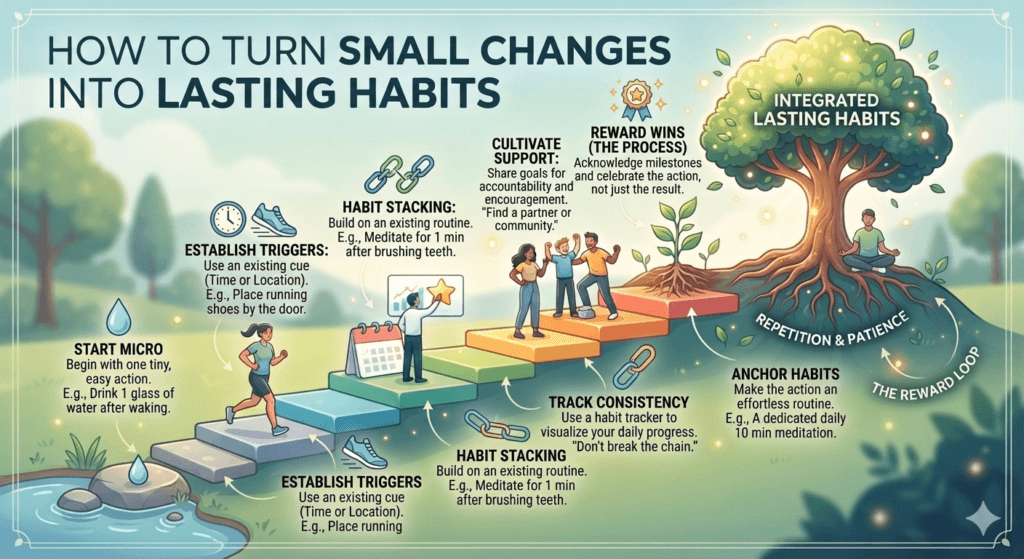
Making a healthy change is often easier than making it last. Instead of relying on motivation or trying to transform everything at once, learn how to turn small improvements into routines that fit naturally into your life.
Starting a healthy habit can feel surprisingly easy.
Maybe you decide to start walking every day.
You prepare healthier breakfasts.
You bring a water bottle to work.
You stop buying snacks from the vending machine.
For a while, things go well.
Then work gets busy.
You have a bad night’s sleep. You travel. The weather changes. Your schedule gets disrupted. You miss a day, then another.
Before long, the new routine has quietly disappeared.
If you’ve experienced this before, you might assume the problem is motivation or discipline.
But there’s another possibility:
The change was simply too difficult to maintain in your real life.
Creating lasting habits isn’t necessarily about becoming better at forcing yourself to do things.
It’s about finding changes that are useful, making them easy enough to repeat, and building routines that can survive imperfect days.
Here’s how.
1. Start smaller than you think you need to
When we decide to improve something, it’s tempting to make the change significant enough to feel meaningful.
If you want to become more active:
“I’ll exercise for an hour five days a week.”
If you want to eat better:
“I’ll prepare all my meals from scratch.”
If you want to improve your mornings:
“I’ll get up an hour earlier, exercise, meditate and make breakfast.”
There’s nothing inherently wrong with any of those goals.
The problem is the size of the starting commitment.
A smaller version might be:
Walk for five minutes after dinner.
Or:
Prepare tomorrow’s breakfast tonight.
Or:
Bring one planned snack to work.
A small change can seem almost too easy.
That’s actually one of its strengths.
You can always build on it later.
First, prove that the behaviour fits into your life.
2. Make the habit specific
Consider this goal:
“I’m going to drink more water.”
When?
Where?
How will you remember?
Compare it with:
“When I sit down to start work, I’ll put a full water bottle on my desk.”
Now the behaviour has a clear situation attached to it.
The same idea works with other habits.
Instead of:
“I’ll walk more.”
try:
“After dinner, I’ll go outside for a short walk.”
Instead of:
“I’ll eat a better breakfast.”
try:
“When I clean up after dinner, I’ll decide what I’m having for breakfast tomorrow.”
Instead of:
“I’ll eat healthier snacks.”
try:
“I’ll put tomorrow’s snack in my work bag tonight.”
The more specific the action, the less you have to decide when the moment arrives.
3. Attach the new habit to something you already do
One of the easiest ways to remember a new behaviour is to connect it to an existing routine.
You already have dozens of potential cues throughout your day:
- getting out of bed
- brushing your teeth
- making coffee
- eating breakfast
- starting work
- eating lunch
- finishing work
- eating dinner
- getting ready for bed
Instead of creating a completely separate event, add something to one of those existing routines.
For example:
After I make coffee → I’ll fill my water bottle.
After lunch → I’ll walk for five minutes.
After dinner → I’ll prepare tomorrow’s breakfast.
Before I leave work → I’ll decide what I’m making for dinner.
You don’t have to remember the new habit out of nowhere.
Something that already happens becomes the reminder.
4. Reduce the number of steps
Suppose you want to walk in the morning.
Your current sequence might be:
Wake up.
Decide whether to walk.
Find clothes.
Find socks.
Find shoes.
Check the weather.
Decide where to go.
Eventually decide you don’t have enough time.
Now imagine that the night before you:
- put out your clothes
- put your shoes beside them
- decide where you’ll walk
Morning arrives and most of the decisions have already been made.
The walk itself hasn’t become easier.
Starting has.
This principle applies almost everywhere.
Want to eat fruit?
Wash it and make it visible.
Want to prepare breakfast?
Put the ingredients together.
Want to bring lunch?
Pack it while cleaning up dinner.
Want to exercise?
Prepare your clothes or equipment beforehand.
Whenever a habit isn’t happening, ask:
What is the first annoying or inconvenient step?
Then see if you can remove it.
5. Change your environment
We often think habits happen entirely inside our heads.
But look around you.
Your environment is constantly giving you cues about what to do.
Food on the kitchen counter gets noticed.
A phone beside you gets checked.
Shoes beside the door remind you that you planned to walk.
A water bottle on your desk gets used more easily than one sitting in a cupboard.
You can use this intentionally.
Make behaviours you want to encourage:
visible + convenient + prepared
And behaviours you want to make less automatic:
less visible + slightly less convenient
You don’t need to completely redesign your home.
Sometimes moving one thing is enough to change what happens next.
6. Create a minimum version for busy days
Imagine your normal habit is:
Walk for 30 minutes after dinner.
Then Wednesday happens.
You get home late. Dinner takes longer than expected. You’re tired.
You have two choices:
30-minute walk
or
nothing
Nothing has a pretty good chance of winning.
Instead, give your habit a minimum version.
Normal: Walk for 30 minutes.
Minimum: Walk for five minutes.
The same principle can apply elsewhere.
Breakfast
Normal: Prepare a complete breakfast.
Minimum: Have a convenient breakfast option already available.
Meal preparation
Normal: Prepare several meals.
Minimum: Make extra dinner for tomorrow.
Hydration
Normal: Refill your bottle throughout the day.
Minimum: Start work with one full bottle beside you.
Your minimum version gives you somewhere to go when circumstances aren’t ideal.
7. Design the habit for a busy Wednesday
It’s easy to create a healthy routine for an imaginary version of your life.
You have plenty of time.
You’re well rested.
Nothing unexpected happens.
You’re highly motivated.
That’s not the version of your life that needs the system.
Instead, ask:
Could I still do some version of this on a busy Wednesday?
If the answer is no, you may need to simplify it.
This doesn’t mean you should never do anything difficult.
It means the routine needs some flexibility.
A habit that works only under perfect conditions will regularly be interrupted by normal life.
8. Use defaults to reduce decisions
You don’t need unlimited options for every decision.
Sometimes defaults make life considerably easier.
For breakfast, perhaps you have three usual choices.
For dinner, you have three quick meals you can make when you’re busy.
For movement, you normally walk after dinner.
For hydration, you normally bring a bottle when you leave the house.
The word normally matters.
These aren’t rigid rules.
They’re defaults.
You can choose something different whenever you want.
But when you don’t want to think about it, the decision has already been made.
That’s one of the hidden benefits of habits:
They reduce the amount of mental effort ordinary decisions require.
9. Expect interruptions
No matter how well you design your habits, something will eventually interrupt them.
Travel.
Illness.
Work.
Family obligations.
Vacations.
Bad weather.
A terrible night’s sleep.
That’s not a flaw in your system.
That’s life.
The important question isn’t:
“How do I make sure I never miss a day?”
It’s:
“What do I do after I miss one?”
One of the most useful answers is also the least dramatic:
Return to your normal routine when you reasonably can.
No punishment.
No trying to compensate.
No waiting for a new week or month.
Just the next repetition.
10. Don’t wait until Monday
There’s something strangely attractive about starting over on Monday.
Or January 1.
Or the first of the month.
It feels clean.
But healthy habits don’t require a ceremonial restart.
If breakfast didn’t go as planned this morning, you can prepare tomorrow’s tonight.
If you didn’t walk yesterday, you can walk today.
If you’ve been eating differently while traveling, return to your normal meals when you’re home.
You haven’t ruined anything.
There isn’t a streak you need to rebuild from zero.
Your next opportunity is simply the next opportunity.
11. Don’t try to change everything at once
Suppose you decide you want to become healthier.
You could simultaneously try to:
- completely change your diet
- start exercising
- drink more water
- improve your sleep
- prepare every meal
- stop snacking
- start meditating
- create a morning routine
That’s a lot of moving pieces.
And if the whole system collapses after two weeks, it’s difficult to know why.
Instead, choose one or two changes.
Try them.
Observe what happens.
Adjust them.
Once they require relatively little thought, experiment with something else.
This creates a much simpler process:
Try → Observe → Adjust → Repeat
You’re learning what works rather than trying to become a completely different person overnight.
12. Keep the changes that give you the best return on effort
Not every healthy habit is equally valuable to you.
Suppose you try two approaches to lunch.
Approach A
Spend two hours every Sunday preparing five lunches.
It works—but you hate doing it.
Approach B
Cook extra dinner and take leftovers to work.
It takes almost no additional effort and solves the same problem.
Which should you keep?
Probably Approach B.
This is worth actively looking for.
Ask:
Which small changes make something noticeably better without adding much work?
Those are excellent candidates for long-term habits.
13. Track habits if tracking helps you
Some people find habit trackers motivating.
Seeing:
| Habit | Mon | Tue | Wed | Thu | Fri |
|---|---|---|---|---|---|
| Prepared breakfast | ✓ | ✓ | ✓ | ✓ | |
| Walked after dinner | ✓ | ✓ | ✓ |
can make an otherwise invisible pattern easier to notice.
But there’s an important distinction.
The goal isn’t:
Never break the streak.
The goal is:
Is this behaviour becoming a regular part of my life?
If tracking helps answer that question, use it.
If maintaining the tracker becomes another obligation, don’t.
The tool should support the habit.
The habit shouldn’t exist to satisfy the tool.
14. Pay attention to what you’re getting from the old habit
Sometimes a behaviour keeps coming back because it serves a purpose.
Suppose you regularly snack late at night.
You could simply decide:
“I need to stop doing that.”
But first ask:
What am I getting from it?
Maybe you’re actually hungry.
Maybe it’s part of relaxing after a stressful day.
Maybe eating has become associated with watching television.
Maybe you’re bored.
Maybe it’s simply something you’ve done for years.
Those are different problems.
And they may need different solutions.
Instead of only trying to suppress a behaviour, understand what role it plays.
Then you have a better chance of changing it.
15. Replace a habit rather than leaving an empty space
If you remove something from a routine, it can help to decide what happens instead.
Rather than:
“Don’t sit all evening.”
try:
“After dinner, I’ll go outside for a few minutes before sitting down.”
Rather than:
“Don’t buy something from the vending machine.”
try:
“I’ll keep a snack in my work bag.”
Rather than:
“Stop ordering dinner when I’m busy.”
try:
“I’ll keep one easy backup meal available.”
You’re not just removing a behaviour.
You’re giving yourself an alternative when the same situation appears.
16. Make the habit something you don’t hate
Imagine two forms of exercise provide similar benefits for your purposes.
You hate one.
You enjoy the other.
Which are you more likely to keep doing?
Enjoyment matters.
If you hate running, find another way to move.
If you hate meal prepping for an entire week, don’t.
If you dislike plain water, experiment with ways to make it more appealing.
If you hate a particular “healthy” food, choose another nutritious food.
There is rarely only one acceptable way to build a healthy routine.
Finding something you actually like—or at least don’t dread—can dramatically improve your chances of repeating it.
17. Let small habits grow naturally
Starting small doesn’t mean staying small forever.
Suppose you begin with:
Walk five minutes after dinner.
Eventually five minutes feels automatic.
Some evenings you walk ten.
Then twenty.
Maybe eventually you decide you’d like longer walks on weekends.
You didn’t need to create the final routine on Day 1.
The habit grew.
The same can happen with food.
Maybe you start by preparing breakfast the night before.
Eventually you prepare several breakfasts.
Then perhaps you begin preparing lunches too.
Let complexity come after consistency, not before it.
18. But remember: small habits are allowed to stay small
There’s another possibility.
Your five-minute walk might stay a five-minute walk.
That’s okay.
Not every habit needs to evolve into a major project.
If keeping a water bottle on your desk helps, you don’t need a hydration tracking app.
If preparing tomorrow’s snack works, you don’t need to start preparing every meal for the week.
If a convenient breakfast solves your morning problem, you don’t need to create an elaborate breakfast routine.
We have a tendency to optimize things that are already working.
Sometimes the better strategy is:
Keep doing the simple thing.
19. Focus on systems rather than motivation
Motivation changes.
Some mornings you wake up ready to do everything.
Other mornings you don’t.
A useful system reduces how much the outcome depends on that difference.
For example:
Goal
Eat a better breakfast.
System
Decide tomorrow’s breakfast while cleaning up dinner.
Goal
Move more.
System
Walk after lunch.
Goal
Drink more water.
System
Fill a bottle before starting work.
Goal
Eat better during busy weeks.
System
Keep three easy meals and one backup meal available.
The goal tells you what you’d like to accomplish.
The system tells you what to do.
20. Review your habits occasionally
A habit doesn’t deserve a permanent place in your life just because you successfully created it.
Every so often, ask:
Is this still helping me?
Maybe your schedule changed.
Maybe you found a simpler approach.
Maybe the problem the habit originally solved no longer exists.
Maybe it requires more effort than it’s worth.
Healthy routines should evolve as your life evolves.
Dropping or changing a habit that no longer serves you isn’t failure.
It’s another adjustment.
A simple framework for making a healthy change last
If you want to turn something you’re currently trying into a lasting routine, work through these six questions.
1. What exactly am I going to do?
Be specific.
“Walk for five minutes.”
2. When will I do it?
Give it a cue.
“After dinner.”
3. How can I make starting easier?
Reduce friction.
“Keep my walking shoes by the door.”
4. What’s my busy-day version?
Create a minimum.
“Walk to the end of the street and back.”
5. What usually gets in the way?
Anticipate the problem.
“I sit down immediately after dinner and don’t want to get back up.”
6. How will I know if it’s worth keeping?
Define success realistically.
“I’m doing it fairly regularly, it fits my life, and I feel better having more movement in my day.”
That’s a habit system.
Not a promise to be perfect.
Try a 7-day experiment
If there’s a change you’ve been thinking about, don’t commit to doing it forever.
Try it for seven days.
Choose something small.
Maybe:
Prepare breakfast the night before.
Keep water beside your desk.
Bring a planned afternoon snack.
Walk for five minutes after dinner.
Make extra dinner for tomorrow’s lunch.
Then observe.
At the end of the week, ask:
Was it useful?
Did it improve something that matters to you?
Was it easy enough?
Could you realistically continue it?
What got in the way?
Can you remove or reduce that obstacle?
Did I enjoy it?
Or at least not dread it?
Could I make it simpler?
Maybe the smaller version would work better.
Then decide:
Keep it.
Modify it.
Or drop it and try something else.
All three are legitimate outcomes.
Because you’re experimenting, not failing.
Consider signing up for our free 7 Day Health Shakeup guide
You don’t need a complete health transformation
There’s an enormous amount of advice about what you should be doing.
Eat this.
Don’t eat that.
Exercise this much.
Drink this much.
Follow this morning routine.
Buy this.
Track that.
It can make getting healthier feel like another full-time job.
It doesn’t have to.
Start with something that’s causing friction in your life.
Ask:
What small change might make this easier?
Try it.
See what happens.
If it helps, keep it.
If it doesn’t, change the approach.
Then, when that first improvement becomes part of your normal life, decide whether there’s something else you’d like to work on.
That’s how small changes can gradually become something much bigger:
not through one dramatic transformation, but through routines that are useful enough and easy enough that they stick around.
Try something different.
Notice what works.
Keep what helps.
And when something isn’t working?
Shake it up.