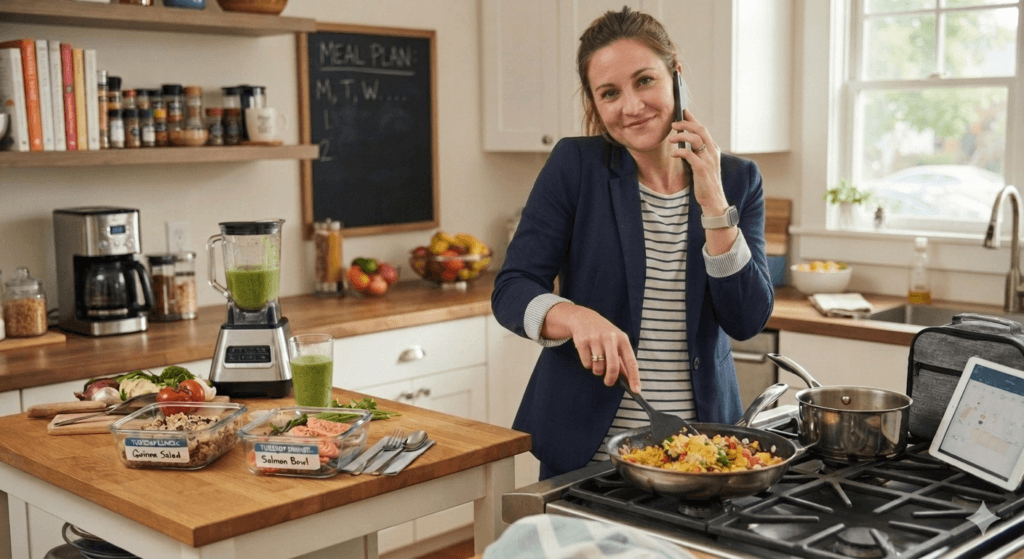
Eating well can feel difficult when you’re short on time. Instead of relying on motivation or trying to prepare everything from scratch, build a few simple systems that make nutritious choices easier on your busiest days.
You finish a long day and realize you haven’t thought about dinner.
You’re hungry. You’re tired. There isn’t much prepared in the refrigerator.
At that point, the question probably isn’t:
“What meal would best support my long-term health?”
It’s:
“What’s the easiest thing I can eat right now?”
And that’s an important distinction.
Sometimes the problem isn’t that we don’t know what healthier eating looks like. The problem is that the option we intended to choose requires more time, preparation or effort than we have available at that moment.
So instead of trying harder to make the “right” choice, there’s another approach:
Make the choice you want to make easier.
You don’t need to prepare every meal from scratch, spend your Sunday cooking for the entire week, or follow a complicated meal plan.
A few simple systems can make a surprisingly big difference.
Here are some worth experimenting with.
1. Stop planning for your ideal week
It’s easy to create a healthy eating plan for an imaginary version of your life.
You’ll cook breakfast every morning.
Pack a beautiful lunch.
Prepare dinner from scratch.
Cut vegetables for snacks.
Never get home late.
And somehow clean everything afterward.
Then real life happens.
A meeting runs late. Someone needs to be somewhere. You’re tired. You forgot an ingredient. Plans change.
Instead of asking:
“How would I eat if everything went according to plan?”
try asking:
“What will I eat when things don’t go according to plan?”
That’s where a useful food strategy begins.
You need meals for good days.
But you also need meals for busy days, tired days and nothing-went-as-planned days.
2. Create three levels of meals
One way to do this is to stop expecting every meal to require the same amount of effort.
Create three categories.
Level 1: I have time
These are the meals you enjoy preparing when you have the time and energy.
Maybe that’s:
- a stir-fry
- homemade soup
- curry
- pasta with vegetables
- tacos
- grain bowls
- a cooked breakfast
Great.
Keep making them.
Level 2: I have about 10 minutes
Now you need easier options.
For example:
- eggs or tofu + whole-grain toast + fruit
- canned beans + microwaveable grains + vegetables + salsa
- hummus + vegetables + pita
- yogurt + fruit + nuts or seeds
- soup + whole-grain bread
- a simple sandwich or wrap with vegetables
- leftovers from yesterday
Level 3: I have virtually no time
This is where many healthy-eating plans fall apart.
Create alternatives specifically for these situations.
Maybe:
- a meal-replacement shake
- prepared soup
- a simple frozen meal that fits your needs
- yogurt + fruit + nuts
- a sandwich made from ingredients you always keep available
- leftovers you froze earlier
These aren’t necessarily your dream meals.
They’re your backup system.
And having a reasonable Level 3 option available can be much more useful than having an ambitious Level 1 meal planned that you don’t have time to make.
3. Choose a few default meals
You don’t need dozens of recipes.
In fact, having too many options can create another problem:
decision fatigue.
Imagine coming home tired and asking:
“Which of these 47 healthy recipes should I make?”
Compare that with:
“It’s Tuesday. I’ll make one of my three quick dinners.”
Try identifying:
3 breakfasts
3 lunches
3 dinners
that you like, are relatively easy to prepare, and use ingredients you can normally keep available.
For example:
Breakfast
- Overnight oats
- Yogurt + fruit + nuts
- Meal-replacement shake
Lunch
- Hummus and vegetable wrap
- Leftover dinner
- Grain + bean + vegetable bowl
Dinner
- Stir-fry
- Pasta + vegetables + protein source
- Tacos or burrito bowls
You’re not required to eat these every week.
They’re simply your defaults.
When you don’t feel like deciding, you already have an answer.
4. Prepare ingredients instead of entire meals
“Meal prep” often brings to mind spending Sunday afternoon filling 15 identical containers.
If that works for you, great.
But it isn’t the only way to prepare ahead.
Instead of preparing complete meals, prepare components.
For example:
- wash fruit
- cut vegetables
- cook grains
- prepare beans or another protein source
- make a dressing
- portion snacks
- prepare overnight oats
- wash salad greens
- make a batch of soup
- cook extra food for leftovers
Now those ingredients can become different meals.
Cooked rice, beans and vegetables might become:
Monday: grain bowl
Tuesday: burrito
Wednesday: stir-fry
Preparation still saves time, but you aren’t committed to eating the same meal repeatedly.
5. Cook once, eat twice
This may be the easiest form of meal prep.
When you’re already cooking, make more.
If you’re preparing dinner tonight, deliberately make enough for tomorrow’s lunch or another dinner.
You’re already:
- getting the ingredients out
- chopping
- cooking
- using the stove
- washing dishes
Increasing the quantity usually requires much less effort than preparing an entirely separate meal tomorrow.
You can also freeze appropriate extra portions for later.
Over time, your freezer can become a collection of meals you already cooked rather than just a place where forgotten food goes to disappear.
6. Use convenience foods strategically
“Processed” is sometimes treated as though it’s synonymous with unhealthy.
That’s too simplistic.
Food processing exists on a spectrum, and some convenient foods can make nutritious eating considerably easier.
Depending on your needs, useful options might include:
- frozen vegetables
- frozen fruit
- canned beans
- canned lentils
- canned tomatoes
- pre-washed salad greens
- pre-cut vegetables
- microwaveable whole grains
- prepared hummus
- plain or lower-added-sugar yogurt
- frozen meals with a nutritional profile that fits your needs
Frozen broccoli doesn’t become nutritionally worthless because someone else washed and cut it for you.
Canned beans don’t stop being beans because you didn’t soak them overnight.
Convenience has value.
The question isn’t:
“Was every part of this meal made from scratch?”
It’s:
“Does this help me put together a meal that works for me?”
7. Keep a few “meal building blocks” available
You can make meals much easier if you regularly keep foods from a few broad categories available.
Think:
Protein source
Examples might include:
- beans
- lentils
- tofu
- eggs
- yogurt
- cottage cheese
- fish, poultry or other foods if they’re part of your diet
- an appropriate meal-replacement product
Vegetables or fruit
Fresh is great.
Frozen and canned can be useful too.
Carbohydrate or whole-grain option
For example:
- oats
- brown rice
- quinoa
- whole-grain bread
- tortillas
- potatoes
- pasta
Something that adds flavor
This part is easy to underestimate.
Maybe:
- salsa
- hummus
- pesto
- herbs
- spices
- hot sauce
- a dressing you like
Now dinner doesn’t necessarily require a recipe.
You can assemble:
grain + beans + vegetables + salsa
or:
toast + eggs/tofu + vegetables + fruit
or:
pasta + vegetables + protein source + sauce
You’re assembling rather than cooking from a detailed set of instructions.
8. Make your freezer part of the plan
Your freezer is one of the best tools available for making food convenient.
Keep things such as:
- frozen vegetables
- frozen fruit
- bread
- cooked grains
- appropriate leftovers
- homemade soup
- prepared meals
- other foods you regularly use
And when you cook something that freezes well, consider making extra.
The goal is eventually to be able to open the freezer on a chaotic Wednesday evening and think:
“I already solved this problem three weeks ago.”
That’s preparation paying you back.
9. Have an emergency meal
Everyone should have at least one meal that requires almost no thought.
Not the meal you’d serve at a dinner party.
Not your ideal meal.
Your:
“I just got home, I’m hungry, and I am absolutely not cooking” meal.
Maybe that’s:
Soup + bread + fruit
or:
Beans + microwaveable rice + salsa
or:
Eggs/tofu + toast + fruit
or:
A convenient meal-replacement shake
The exact meal isn’t important.
What matters is that:
- You generally keep the ingredients available.
- You don’t have to think about what to make.
- You can prepare it quickly.
You’re designing for the moment when your decision-making ability is at its lowest.
10. Consider a meal-replacement shake when convenience really matters
This is one situation where a meal-replacement shake can make sense.
There’s a difference between believing:
“Shakes are healthier than real food.”
and saying:
“There are times when having a convenient, nutritionally useful meal available helps me eat more consistently.”
I strongly prefer the second way of thinking about them.
I’ve used Isagenix shakes for more than 10 years, particularly as a breakfast staple and as part of my workout nutrition.
What I value most is the simplicity.
On a busy morning, I don’t have to decide what to cook or skip breakfast because I ran out of time. I have an option I can prepare quickly that contributes protein and other nutrients to my day.
For me, that provides a kind of nutritional peace of mind.
It doesn’t mean the rest of my diet doesn’t matter.
It means I’ve made one meal easier.
And that’s often enough.
If you’re interested in this approach, I’ve written a separate guide explaining the different Isagenix shakes, their nutritional profiles, who they’re designed for, and my experience using them.
→ Read My IsaLean Shake Guide & Review
11. Make breakfast almost automatic
Breakfast is particularly well suited to default meals because many people don’t mind repeating breakfast more frequently than dinner.
Instead of inventing breakfast every morning, create a rotation.
For example:
Option 1: Overnight oats
Option 2: Yogurt + fruit + nuts
Option 3: Toast + substantial toppings
Option 4: Meal-replacement shake
We’ve put together a more detailed list here:
→ Healthy Breakfast Ideas for Busy Mornings
Even better, prepare whatever you can the night before.
Morning-you will appreciate the help.
12. Don’t wait until you’re hungry to think about snacks
Snacks have the same convenience problem as meals.
When you’re already hungry, the easiest option has an enormous advantage.
So create that advantage yourself.
Keep things such as:
- fruit
- vegetables + hummus
- nuts and seeds
- yogurt
- roasted chickpeas
- whole-grain crackers + toppings
- another snack you enjoy
ready to grab.
We cover this strategy in much more detail here:
→ Easy Healthy Snack Ideas for Busy Days
The principle is the same:
Preparation changes what is convenient.
13. Create a useful shopping list
A shopping list doesn’t have to contain a detailed plan for seven different dinners.
You can create a default list of foods you regularly use.
For example:
Produce
- bananas
- apples
- berries
- salad greens
- carrots
- peppers
- frozen vegetables
Protein-rich foods
- beans
- lentils
- tofu
- eggs
- yogurt
- nuts/seeds
Meal bases
- oats
- bread
- tortillas
- rice
- pasta
- potatoes
Convenience
- frozen vegetables
- frozen fruit
- canned beans
- soup
- microwaveable grains
Flavor
- hummus
- salsa
- sauces
- herbs and spices
Then add whatever you need for specific meals that week.
A reusable list reduces the amount of planning required every time you shop.
14. Consider grocery delivery or pickup
Sometimes spending a little money to remove friction is worthwhile.
If grocery shopping regularly takes a large amount of time or causes you to postpone buying food, grocery pickup or delivery may help.
Yes, there may be fees or markups depending on the service.
But consider the full equation.
If grocery delivery helps you keep useful foods at home and reduces last-minute restaurant or takeout purchases, the cost may be easier to justify.
This is another example of something we often overlook:
Your time has value too.
The cheapest solution isn’t always the most useful solution.
15. Make the food you want to eat visible
Imagine opening the refrigerator.
At eye level you see:
washed fruit
prepared vegetables
hummus
leftovers
yogurt
Behind them are other foods.
Now imagine the same foods hidden in drawers and opaque containers.
The food hasn’t changed.
The environment has.
When possible, put the things you want to remember somewhere visible and easy to access.
You can also create:
a breakfast area
a snack area
a grab-and-go shelf
or whatever organization works for your household.
You’re using your environment to remind you instead of relying entirely on memory.
16. Make less helpful choices slightly less convenient
The same principle works in reverse.
You don’t need to ban foods you enjoy from your house.
But you also don’t need to put every snack directly in front of you.
For example, foods you want to eat more often can be:
visible + prepared + accessible
while foods you want to eat less frequently can simply be:
less visible + less automatic
This isn’t about labeling one food “good” and another “bad.”
It’s about recognizing that convenience influences behavior.
Use that knowledge intentionally.
17. Have a plan for takeout
Eating well when you’re busy doesn’t necessarily mean never ordering food.
Sometimes takeout is the practical solution.
Instead of waiting until you’re exhausted and scrolling through dozens of options, identify a few meals from nearby places that work well for you.
Then you have another default:
“If we’re ordering tonight, these are a few options I already know I like.”
You can still choose something else.
You’re simply reducing the amount of decision-making required.
18. Don’t turn healthy eating into an all-or-nothing test
One of the easiest ways to make healthy eating harder is to decide that if you can’t do it perfectly, there’s no point trying.
Maybe lunch wasn’t what you’d planned.
That doesn’t determine dinner.
Maybe you ordered pizza.
That doesn’t mean the rest of the week is ruined.
Maybe you didn’t prepare meals Sunday.
You can prepare something Monday night.
There is no nutritional reset button you have to wait until next week to press.
Your next opportunity is simply:
the next meal.
That’s a much more useful mindset than constantly being either “on” or “off” a healthy eating plan.
19. Healthy convenience is still healthy convenience
There’s an interesting bias many of us have around effort.
A meal somehow feels more legitimate if we spent 45 minutes preparing it.
But your body doesn’t award bonus points because you personally chopped every vegetable.
Sometimes the better solution is:
frozen vegetables
instead of vegetables you intended to chop but didn’t.
canned beans
instead of dried beans you never got around to cooking.
prepared hummus
instead of homemade hummus.
a simple meal replacement
instead of skipping a meal.
The objective isn’t maximum culinary effort.
It’s creating an eating pattern you can actually maintain.
20. Improve the system one problem at a time
Don’t read this article and decide you need to reorganize your kitchen, create a meal plan, start batch cooking, order new containers and completely change how you shop.
Instead, identify your biggest friction point.
Ask:
When does healthy eating become hardest for me?
Is it:
Breakfast?
Prepare it the night before.
Lunch at work?
Pack something or deliberately make dinner leftovers.
Afternoon snacks?
Create an emergency snack supply.
Dinner after work?
Create three 10-minute default meals.
Grocery shopping?
Create a reusable shopping list or try pickup.
Nothing available when you’re rushed?
Create an emergency meal.
Solve one recurring problem.
Then see what happens.
A simple busy-day eating system
If you want somewhere concrete to start, try this:
Breakfast
Choose two regular options + one emergency option.
For example:
Overnight oats / yogurt and fruit / meal-replacement shake
Lunch
Make extra dinner and deliberately use leftovers.
Snack
Keep one portable option available.
Fruit + nuts, for example.
Dinner
Choose three meals you can prepare quickly.
Freezer
Keep at least one backup meal available.
Shopping
Maintain a reusable list of foods you buy regularly.
That’s already a system.
It doesn’t require an elaborate meal-prep spreadsheet.
And you can improve it gradually.
Today’s Shake-Up: Make One Meal Easier
Don’t try to “eat healthier” tomorrow.
That’s too vague.
Instead, choose one meal that regularly causes problems.
Then ask:
How could I remove one step from this meal?
Maybe you’ll:
☐ Prepare breakfast tonight.
☐ Make enough dinner for tomorrow’s lunch.
☐ Buy frozen vegetables instead of relying entirely on fresh ones.
☐ Create three default quick dinners.
☐ Put together an emergency meal.
☐ Prepare a few ingredients rather than complete meals.
☐ Create a reusable grocery list.
☐ Move useful foods somewhere easier to see.
☐ Keep a convenient meal-replacement option available.
☐ Try grocery pickup on an especially busy week.
Then notice what happens.
Did you save time?
Did you eat differently?
Did you feel less stressed about the meal?
Most importantly:
Would you realistically do it again?
If yes, you’ve found something worth keeping.
If not, try another approach.
You don’t need to completely overhaul your diet.
Sometimes improving the way you eat begins by making one meal just a little easier.
And once you’ve done that?
Shake something else up.