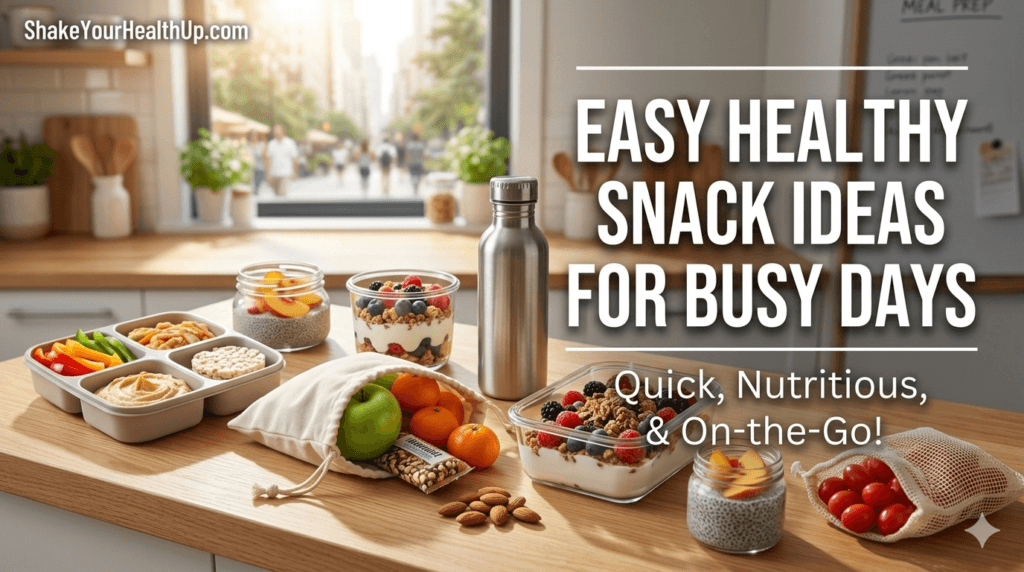
Healthy snacking doesn’t have to mean complicated recipes or hours of meal prep. The key is having satisfying, practical options available before hunger makes the decision for you.
It’s 3:00 in the afternoon.
Lunch was a few hours ago, dinner is still a long way off, and you’re hungry.
You open a cupboard, walk past a vending machine, stop at a convenience store, or look through the break room at work.
At that point, you’re probably not thinking:
“What carefully considered nutritional choice should I make?”
You’re thinking:
“What can I eat right now?”
That’s why improving your snacks isn’t primarily about willpower.
It’s about making an option you want to choose just as easy to grab as the alternatives.
Here are some practical ways to do that.
What makes a good snack?
There’s no single formula every snack needs to follow.
Sometimes you simply want something small to tide you over until your next meal. Other times you need something more substantial because there’s a long gap between meals or you’ve been particularly active.
As a practical starting point, consider snacks that combine foods providing things such as protein, fiber and other useful nutrients.
For example:
Fruit + nuts
Vegetables + hummus
Yogurt + berries
rather than assuming a snack has to come in a package labelled “healthy.”
More importantly, the snack has to be something you’ll actually eat.
A container of vegetables slowly deteriorating in the refrigerator isn’t particularly useful.
The goal is to find a handful of nutritious options you enjoy and then make them convenient.
1. Fruit + nuts or nut butter
Fruit is already one of the world’s most convenient snack foods.
Apples, bananas, oranges and many other fruits require little or no preparation and are easy to take with you.
Pairing fruit with nuts or nut/seed butter can make it a more substantial snack.
Some simple combinations:
- apple + peanut butter
- banana + almond or peanut butter
- pear + walnuts
- berries + almonds
- orange + cashews
There’s no need to make this complicated.
Make it easier
Keep fruit somewhere visible rather than hidden at the back of the refrigerator.
If you’re leaving home, put a piece of fruit in your bag before you get hungry.
If you use nut butter away from home, individual portions can be convenient, although buying a jar and portioning it yourself may be less expensive.
2. Vegetables + hummus
“Eat more vegetables” is easy advice to give.
The problem is that an unwashed head of broccoli isn’t particularly competitive with a bag of chips when you’re hungry.
Preparation changes that.
Try keeping washed and cut vegetables ready to eat:
- carrots
- cucumber
- bell peppers
- celery
- cherry tomatoes
- snap peas
- broccoli or cauliflower, if you enjoy them raw
Pair them with hummus or another dip you enjoy.
The important part happens before you’re hungry
If preparing vegetables every time you want a snack feels like too much work, prepare several portions at once.
Then:
Open refrigerator → grab container → eat
That’s a much fairer competition with packaged convenience food.
3. Yogurt + fruit
Yogurt can be an easy source of protein and other nutrients, depending on the type you choose.
Add fruit and perhaps nuts, seeds or oats to make it more substantial.
For example:
Plain Greek yogurt + blueberries + walnuts
or:
Yogurt + banana + chia seeds
If you prefer flavored yogurt, check the label rather than assuming every yogurt marketed as healthy has a similar nutritional profile. Added sugar can vary considerably between products.
The goal isn’t to avoid sugar at all costs. It’s simply to know what you’re choosing rather than relying on the pictures of fruit on the container.
4. Nuts and seeds
Nuts require virtually no preparation, don’t need refrigeration, and are easy to keep at work or take with you.
Options include:
- almonds
- walnuts
- pistachios
- cashews
- peanuts
- pumpkin seeds
- sunflower seeds
They’re also easy to eat absent-mindedly straight from a large bag.
If that’s something you notice yourself doing, putting some into a small container before you start eating can make the snack more deliberate without requiring you to obsessively measure or count everything.
Make it convenient
Keep a small container in:
your desk
your work bag
your backpack
or another place where you’re frequently caught without a snack.
Just be mindful of allergies—for yourself and people around you, particularly in schools and shared environments.
5. Apple slices or banana with peanut butter
This deserves its own entry because it’s such a simple combination.
You get the sweetness and texture of fruit with the richer flavor of peanut butter or another nut/seed butter.
It takes very little preparation and feels more substantial than fruit alone.
If apples tend to brown before you’re ready to eat them, you can simply bring the whole apple and cut it when needed—or skip cutting it altogether.
Healthy convenience doesn’t have to look impressive on Instagram.
6. Roasted chickpeas
If you prefer something crunchy, roasted chickpeas are worth trying.
You can make them yourself with chickpeas and seasonings or buy them prepared.
They can provide a useful alternative when what you really want from a snack is the experience of eating something crunchy.
That’s an important point.
Sometimes replacing a habitual snack works better when the alternative provides some of the same experience.
If you’re craving something crunchy and salty, a banana may be nutritious—but it probably isn’t addressing what you actually wanted.
Rather than fighting that preference, experiment with alternatives that match it more closely.
7. Whole-grain crackers + a substantial topping
Crackers alone can be easy to keep eating without feeling particularly satisfied.
Instead, use them as a base.
Depending on your dietary preferences, try:
- crackers + hummus
- crackers + cheese
- crackers + nut/seed butter
- crackers + avocado
- crackers + cottage cheese
When choosing crackers, look beyond marketing terms such as “multigrain” or pictures of wheat on the package.
Check the ingredient and nutrition information to understand what you’re actually buying.
8. Hard-boiled eggs
For people who eat eggs, hard-boiled eggs are a convenient make-ahead option.
Prepare several at once, refrigerate them properly, and you’ve created a ready-to-eat snack for the next few days.
You can pair one with:
- fruit
- vegetables
- whole-grain crackers
- another small snack
Again, the advantage isn’t that eggs possess some special ability to make you healthy.
The advantage is that you’ve turned something nutritious into something convenient.
9. Edamame
Edamame is another useful option, particularly if you’re looking for plant-based snacks containing protein.
Frozen edamame can be prepared quickly, and pre-cooked versions can be kept refrigerated according to package directions.
Try it plain or with seasonings you enjoy.
This is also a good example of expanding what you think of as “snack food.”
A snack doesn’t need to be a bar, cookie, chip or individually wrapped product.
It can simply be a small portion of food.
10. Make your own simple trail mix
Trail mix can be convenient, but commercial versions vary enormously.
Some are mostly nuts and seeds.
Others contain large amounts of candy, sweetened fruit or other additions.
There’s nothing inherently wrong with enjoying those ingredients, but if you’re looking for an everyday snack, making your own gives you control over what’s in it.
Start with some combination of:
- almonds
- walnuts
- cashews
- pumpkin seeds
- sunflower seeds
- unsweetened or lightly sweetened dried fruit
- a small amount of another ingredient you enjoy
Put portions into reusable containers or bags.
Now you’ve created a shelf-stable grab-and-go snack.
11. Cottage cheese + fruit or vegetables
If cottage cheese fits your dietary preferences, it’s another simple protein-containing base.
For something sweeter:
cottage cheese + berries or peaches
For something savory:
cottage cheese + tomatoes + pepper
You can also buy individual containers for convenience, although larger containers may be more economical if you’re eating it at home.
12. A simple smoothie
A smoothie can work as a snack without becoming an elaborate recipe containing 14 ingredients.
For example:
fruit + milk or preferred alternative + another ingredient that adds protein
You can also prepare smoothie ingredients ahead of time.
13. Leftovers can be snacks too
This might be the least glamorous idea on the list.
It may also be one of the most practical.
A snack doesn’t need to come from the “snack” aisle.
If there’s a small portion of last night’s meal in the refrigerator and it works for you, eat it.
A little leftover:
- soup
- grain bowl
- beans
- vegetables
- tofu
- pasta
- another meal
can be a perfectly reasonable small meal or snack.
It also reduces food waste.
14. Keep an emergency snack kit
This is one of my favorite strategies because it deals with the actual problem rather than trying to create the perfect snack.
Ask yourself:
Where am I usually caught hungry without a good option?
Maybe it’s:
At work.
In the car.
After exercise.
While running errands.
When traveling.
Put an appropriate shelf-stable backup in that location or in the bag you normally carry.
Depending on your preferences, that might include:
- nuts or seeds
- roasted chickpeas
- suitable whole-grain crackers
- dried fruit
- a nutrition bar you like
- another shelf-stable option
Now you’re planning for the day that doesn’t go according to plan.
That’s often more useful than designing a routine that works only when everything goes perfectly.
15. What about nutrition bars?
Nutrition bars are a great example of why the word “healthy” on the front of a package doesn’t tell you very much.
Some can be useful portable snacks.
Others aren’t dramatically different from candy bars despite being marketed using words such as:
protein
energy
natural
whole grain
or fitness.
Rather than deciding that all bars are either good or bad, turn the package over.
Consider things such as:
- what ingredients it contains
- how much protein and fiber it provides
- added sugar
- how large the serving is
- whether you actually enjoy it
- whether it satisfies you
- what role you want it to play
A bar doesn’t need to be nutritionally perfect to be useful.
If keeping one in your work bag prevents you from regularly being stuck without food for hours, convenience has value.
Just don’t assume the marketing on the wrapper tells the whole story.
Be careful with the “healthy snack” aisle
Walk through a grocery store and you’ll find plenty of products that appear to have been designed specifically to look healthy.
Packaging might emphasize:
Made with real fruit!
Multigrain!
Plant based!
Natural!
Source of vitamins!
Organic!
Those statements may be true.
They also don’t necessarily tell you whether the product is the best choice for what you’re trying to accomplish.
For example, some products marketed as fruit snacks contain relatively little whole fruit. Some granola products contain considerable added sugar. Some veggie chips contain vegetables but are still fundamentally processed snack foods.
Again, this doesn’t mean these foods are forbidden.
It means:
Don’t let the marketing make the decision for you.
Look at the actual food and decide how it fits into your overall eating pattern.
Make the healthier option the easiest option
This is probably more important than any individual food on this list.
Imagine you’re hungry and open the refrigerator.
Refrigerator A
You see:
- unwashed vegetables
- an unopened container of hummus hidden behind other food
- fruit in the bottom drawer
Refrigerator B
At eye level you see:
- washed fruit
- cut vegetables
- hummus
- yogurt
- two prepared snack containers
The nutritional advice hasn’t changed.
The environment has.
Which refrigerator makes your intended choice easier?
That’s the principle behind what behavioral scientists sometimes call choice architecture: the way choices are presented and arranged influences which options are easiest to select.
You can use that deliberately.
Try creating a snack zone
Pick one area of your kitchen and make it your grab-and-go snack area.
In the refrigerator, that might contain:
- washed fruit
- prepared vegetables
- hummus
- yogurt
- hard-boiled eggs
- edamame
In the cupboard:
- nuts
- seeds
- roasted chickpeas
- whole-grain crackers
- trail mix
You don’t need all of those.
Start with three things you actually like.
That’s enough.
Five minutes of preparation can change tomorrow
Before going to bed tonight, spend five minutes making tomorrow’s snack easier.
You could:
☐ Wash some fruit.
☐ Cut vegetables.
☐ Put hummus into a small container.
☐ Portion some nuts.
☐ Pack yogurt and fruit.
☐ Prepare trail mix.
☐ Put an emergency snack in your work bag.
☐ Move your preferred snacks somewhere visible.
☐ Decide what tomorrow afternoon’s snack will be.
You’re not relying on tomorrow’s willpower.
You’re helping tomorrow-you out in advance.
You don’t have to snack
One final point that’s easy to overlook in an article about snacks:
You don’t need to snack simply because it’s a certain time of day.
Some people prefer three meals and rarely want food between them.
Others find a snack useful because of their schedule, appetite or activity.
Rather than creating another eating rule, pay attention to your own routine.
Ask:
Am I hungry?
How long is it until my next meal?
Is this a habitual snack I don’t particularly want?
Am I looking for a break rather than food?
Would eating something now make the rest of my day easier?
The goal isn’t to become perfect at snacking.
It’s to become a little more intentional.
Today’s Shake-Up
Choose one thing to experiment with today:
☐ Prepare tomorrow’s snack tonight.
☐ Pair fruit or vegetables with something more substantial.
☐ Create an emergency snack kit.
☐ Move your preferred snacks somewhere easier to see.
☐ Create a dedicated snack area in your refrigerator or cupboard.
☐ Check the label of one packaged snack you regularly buy.
☐ Try a different snack that better matches what you actually want—sweet, savory, creamy or crunchy.
Then notice what happens the next time you’re hungry.
Did preparation change your choice?
Did the snack satisfy you?
Was it convenient enough?
Would you realistically do it again?
If the answer is yes, keep it.
If not, try something different.
That’s your next shake-up.